Hypnosis is visible in the brain. And measurable.
Together with the University of Zurich, we study what happens in the brain during hypnosis. This led to three publications, in 2023 and 2024, in Frontiers in Human Neuroscience, Cortex and Scientific Reports.
We see every day that hypnosis works. Our job is to provide the evidence.
OMNI Hypnosis International is an institute for hypnosis training. Our goal is to establish hypnosis and hypnotherapy and to win acceptance for them by describing the underlying mechanisms in detail.
What the study shows
- 01
There are at least two hypnotic states.
The studies show that at least two different states of hypnosis exist: somnambulism and the Esdaile state. The question often debated in academic circles, whether hypnosis is a state of its own at all, is now settled.
- 02
Hypnosis changes networks in the brain.
The studies show measurable changes in brain networks during hypnosis. The fMRI study also found differences between the two depths of hypnosis, and the EEG study changes in brain activity at high temporal resolution.
- 03
The neurochemical environment changes too.
A first was the study with magnetic resonance spectroscopy: in deep hypnosis, the ratio of myo-inositol to total creatine changed significantly in one of the brain regions studied.
- 04
Parallels to anesthesia, and what participants reported.
Brain patterns in somnambulism show parallels to those under propofol anesthesia, and the reasons need further research. In the Esdaile state, participants reported body boundaries dissolving, deep mental and physical relaxation, losing their sense of space and time, or inner images. Whether this is linked to the measured changes cannot yet be said with certainty.
Three core studies, one project
“Multimodal Investigation of Distinct Hypnotic States”: all participants took part in all three measurements, hypnotized by five trained OMNI hypnosis experts using standardized, ISO 9001 certified inductions. According to the researchers, it was the first hypnosis project worldwide to study two depths of hypnosis with such a standardized, multimodal approach of fMRI, EEG and magnetic resonance spectroscopy. For now, the results apply to the healthy participants with hypnosis experience who were studied.
- fMRI
Activity patterns across the whole brain
Measures the neural activity that comes with each state and describes the functional networks (connectivity).
Source: de Matos et al., 2023, Frontiers in Human Neuroscience
- MRS
Neurochemistry in hypnosis
Builds on the fMRI findings and measures chemical substances in different brain regions, non-invasively. In deep hypnosis, the ratio of myo-inositol to total creatine changed significantly in one region studied.
Source: de Matos et al., 2024, Scientific Reports (Nature Portfolio)
- EEG
Electrophysiology at high temporal resolution
Complements the other two techniques and examines electrophysiological changes between the states.
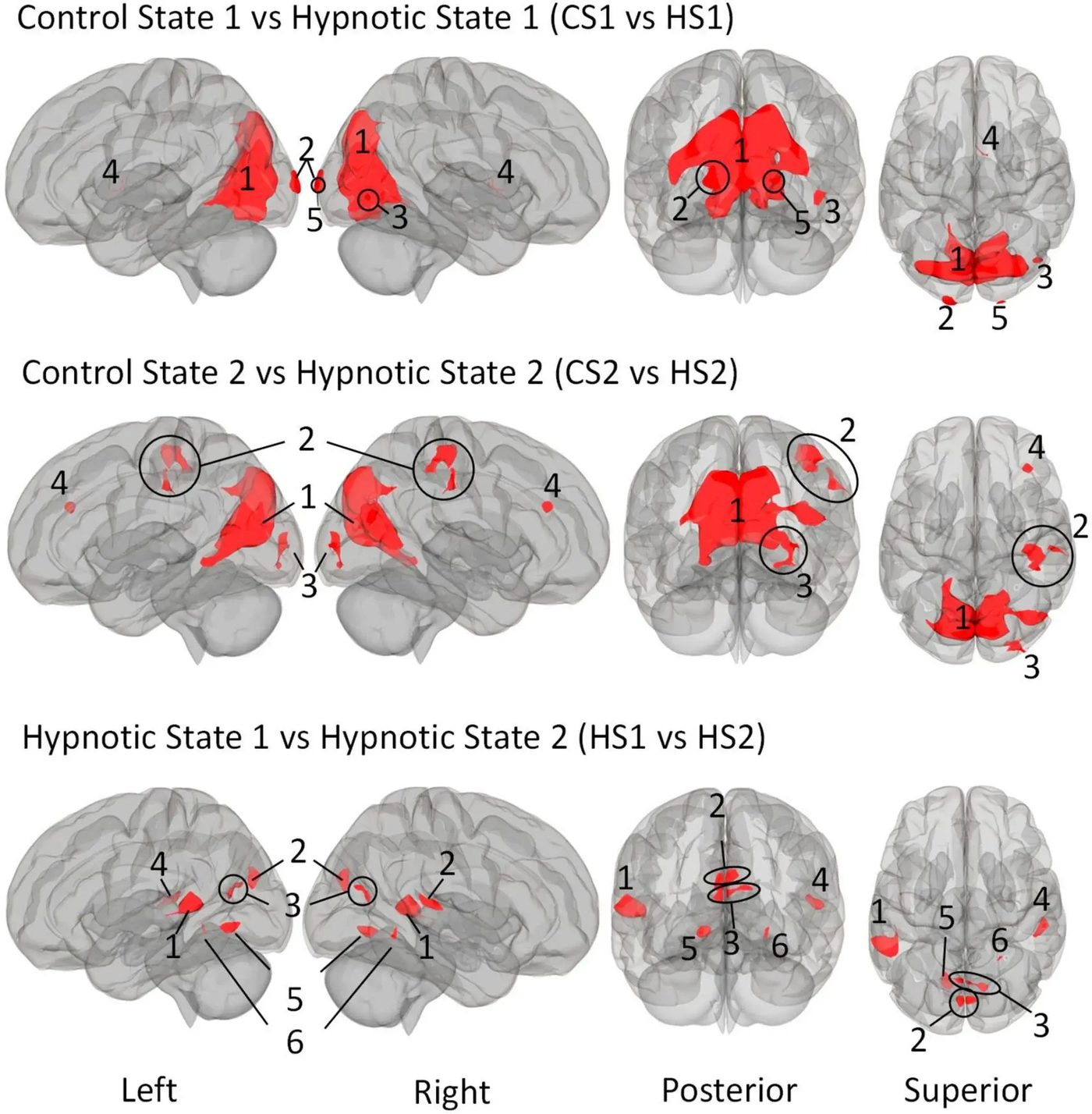
Different brain networks at two depths of hypnosis
The fMRI study made visible that the functional networks in the brain change in distinguishable ways at two depths of hypnosis. The same participants were compared in the control state and in hypnosis.
Read the studyWhat the research means for future OMNI hypnotherapists
In the studies, hypnosis was induced with the OMNI hypnosis induction, based on the methods of Dave Elman and Gerald Kein. The inductions used in the research projects are the same ones you learn in the training. They are standardized and easy to use. From the first day, you learn to hypnotize others reliably and verifiably.
Compare the training pathsWhat this means for medicine and practice
Over 20,000 graduates have completed the OMNI training. In conventional medicine and academia, hypnosis is still often seen as taboo or esoteric, even though clinical studies show good evidence for its effectiveness in irritable bowel syndrome, acute and chronic pain, anxiety and phobias, depression, post-traumatic stress disorder, skin conditions and asthma.
For us, academic medicine and effective hypnosis are no contradiction. We want our graduates to feel as confident as possible, including when they work with medical professionals. Hypnotherapy can ease symptoms, and how quickly varies from person to person. Its broad use can noticeably reduce healthcare costs.
The studies make visible what happens in the brain during hypnosis. That helps to discuss hypnosis in medicine on a factual basis. Recognition as a form of therapy needs further research. A long-term goal of OMNI hypnosis research is for health insurers to recognize hypnosis as a form of therapy. The Swiss television documentary “Wie die Forschung die Hypnose entdeckt” (How research discovers hypnosis, in German) gives insight into this work.


Learn the method.
Learn at the institute that commits to research like no other.
Read the study