Hypnosis for test anxiety: the story of the golden spaghetti
“If I can’t get out of bed in the morning, I don’t have to go to school, and then I don’t have to write any exams.” Sven is 15, and his school diploma is on the line. He studies hard and lets his parents quiz him. Then, in the exam, his mind goes blank. For children and teens like Sven, hypnosis for test anxiety can open a way out, because it works where the fear actually sits.
This article is based on the experience of Barbara Scholl, hypnotherapist and OMNI and HypnoKids® instructor. She explains why children develop test anxiety, what happens in the brain during a blackout and what the golden spaghetti have to do with it.
When exams become a threat
Sven has suffered from crippling test anxiety since his third year of secondary school. Although he prepares carefully, he blacks out again and again during exams, and he feels more and more like a failure.
To protect himself, he sometimes stays home with headaches, stomachaches or nausea. It does not help. Over time, he gives up inside, and he is pulled into a downward spiral that keeps getting faster. His parents feel overwhelmed and helpless.
Sven is not alone. “Exam nerves and school refusal are issues that I have encountered even more frequently in my practice in the last year than before,” Barbara Scholl said at the time.
Why children develop exam anxiety
For many children, Barbara Scholl says, “the serious side of life often begins in kindergarten.” At five or six, they start comparing themselves with others and competing. In the first years of school, many already feel pressure. They want to please their teachers and their parents.
Negative and stressful experiences add up slowly and unnoticed. In Barbara Scholl’s words, they build “a negative emotional trail of experience in the child’s subconscious.” Then all it takes is a final trigger, the straw that breaks the camel’s back, and symptoms appear, such as blackouts during exams.
The vicious circle of performance anxiety
From there, performance anxiety tends to feed itself. The child works harder, does more homework, studies with the parents, goes to tutoring. The pressure grows, and the blackouts become more frequent. Exams turn into something the child dreads on an emotional level.
At home, the next worry waits: how do I tell my parents? Parents may scold, because they are worried about their child’s future. And the circle keeps turning.
At some point, Barbara Scholl observes, some children become desperate, give up and stop learning altogether. That resignation can show up in other ways, too, for example in eating problems or in aggressive behavior at home. If you notice signs like these in your child, talk to your pediatrician.
What happens in the brain during a blackout
Barbara Scholl explains a blackout with the amygdala, the brain’s alarm center. It is controlled by emotion, and it sounds the alarm to protect the child, for example when an exam is coming up.
As soon as the teacher hands out the exam, the alarm goes off. Stress messengers flood the body. The pupils widen, breathing speeds up, the heart races and the hands are drenched in sweat. The body prepares for one thing: escape. Blood rushes to the legs, ready to run.
But the child has to stay in the chair. The part of the brain responsible for logical thinking is not getting what it needs, and a blackout follows. Formulas, numbers and vocabulary are gone. In this state, the child cannot recall what they have learned, however well they studied.
The golden spaghetti
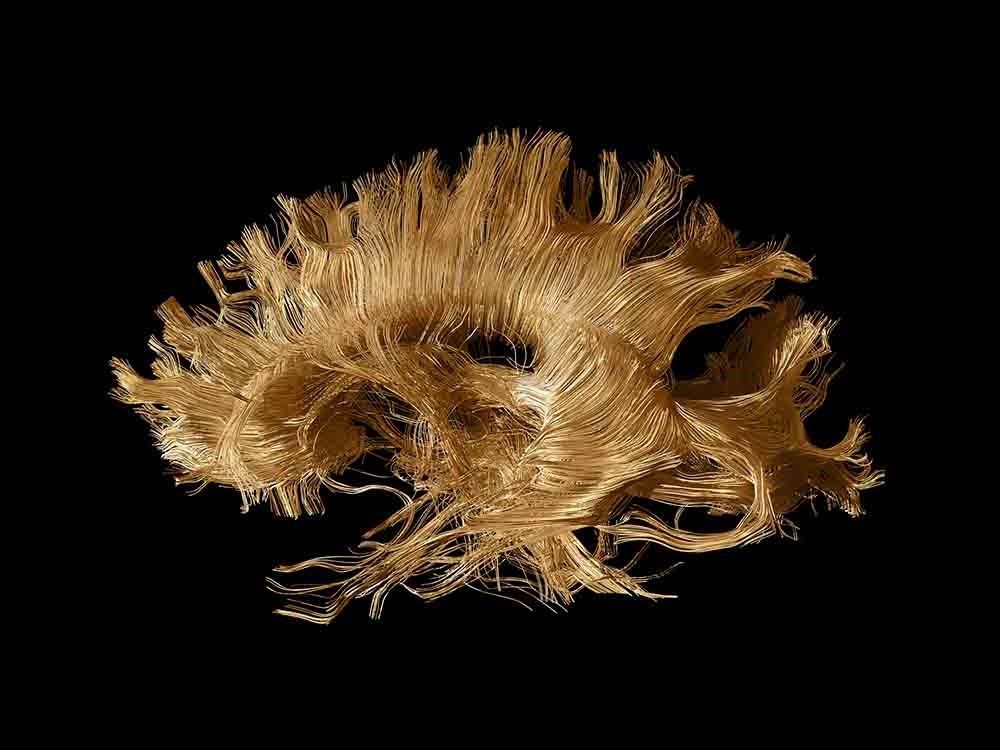
When young people come to Barbara Scholl’s practice because of exam anxiety, she shows them a large art photograph of the human brain. At first glance, it looks as if the brain is made of golden spaghetti. In fact, the picture shows the connections between nerve cells.
With the photo, she explains where the amygdala sits and how it works as an alarm center. For many children, that is a turning point. They realize that willpower does not help against test anxiety. The harder they try, the louder the alarm gets.
“Suddenly the fog clears,” Barbara Scholl says. The children begin to understand that strong emotions in their subconscious take over when things get tense. According to her, this understanding alone brings them great relief.
How exam anxiety hypnosis works with children and teens
Hypnosis is a natural state of focused attention that we all experience every day. In hypnotherapy, children learn to turn their attention inward and to recognize that they have the resources they need. In the sessions, Barbara Scholl often hears: “What, I can talk to my amygdala? So cool!”
The children and teens do the actual work themselves. The hypnotherapist guides them through the process, and they work through the negative emotional experiences. In her experience, one or two sessions are often enough. OMNI hypnotherapy is a short-term approach. As Barbara Scholl sees it, children should be back on the sports field, the trampoline or in an exciting book as quickly as possible, because that is where they belong.
For more on how hypnosis works with young clients, read our article on hypnosis for children and teens.
What Sven’s sessions revealed
In Sven’s case, hypnosis brought an old memory to light. In kindergarten, he had been punished three times by having to sit on a chair and face the wall for several minutes. He did not understand the punishment. He felt exposed in front of everyone and deeply ashamed, and he formed beliefs on an emotional level: “I’m not enough. I’m wrong.”
In elementary school, he was later criticized for provocative behavior, which in turn felt unfair to him. His anger grew, until his grades in secondary school dropped sharply.
After two hypnotherapy sessions, his exam nerves were gone, Barbara Scholl reports. Sven started taking exams again, finished school and began the apprenticeship he had wanted. According to his mother, he is happy again, and his teacher is satisfied with his performance. Every child is different, but Sven’s story shows what becomes possible when the cause is found.
Hypnosis for test anxiety: what parents can do
If your child suffers from test anxiety, Barbara Scholl has clear advice. Do not push your child into a hypnotherapy session. Instead, spark their curiosity, and let them look at the hypnotherapist’s website themselves. Involve teenagers in the decision. “She or he is part of the solution. Hypnosis is always teamwork.”
She also sees value in parents coming to hypnotherapy themselves. When parents let go of their own fears for their child’s future, they can give the child more confidence instead, and that can strengthen the child’s self-esteem.
About Barbara Scholl
Barbara Scholl is an OMNI and HypnoKids® instructor and a hypnotherapist at the OMNI Hypnosis Center in Effretikon, Switzerland. When this article first appeared, she had worked with hypnosis for over 13 years. Before that, she taught English at secondary level for 14 years. She speaks about child and adolescent hypnosis at congresses in Europe and the USA and is the co-author of a book on hypnotherapy for children and adolescents. More at barbarascholl.com.
Your next step: if you want to help children and teens with issues like test anxiety, see the HypnoKids® Specialist training online and learn the OMNI approach to child hypnosis.