HypnoKids®: pediatric hypnosis with the OMNI method
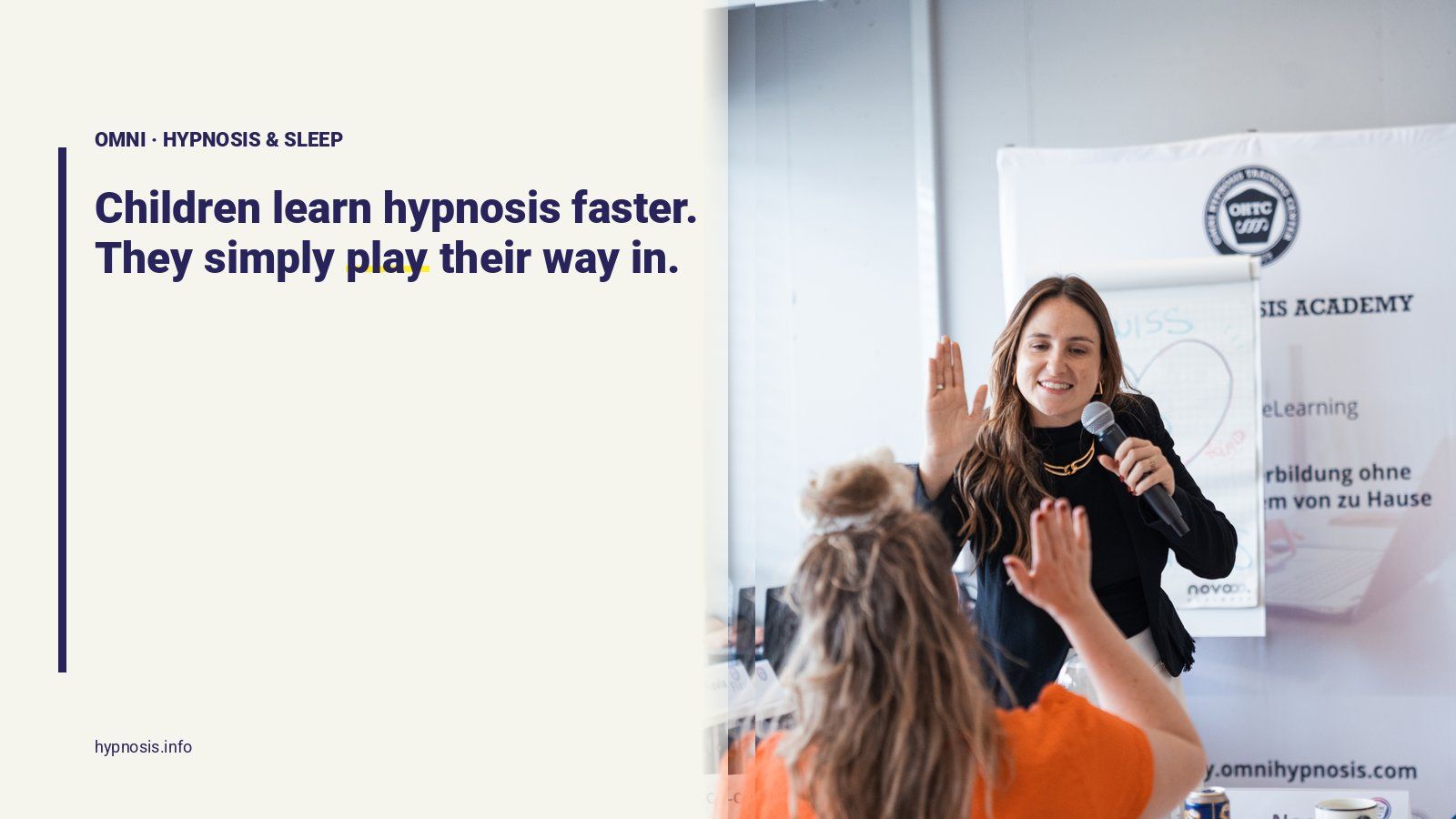
Picture your child at the breakfast table, the report card lying between the cereal bowls, and everything written across that small face. Relief. Pride. Or the quiet pressure that has been building for weeks. In many places, late June marks the last weeks of the school year. For many children, it is a season in which they look smaller than they are. This is where a method OMNI has refined over years finds its purpose: pediatric hypnosis, known at OMNI as HypnoKids®.
What HypnoKids® actually is
Pediatric hypnosis is not a scaled-down version of adult hypnosis. It is a discipline of its own. Children already live in a state that adults have to relearn the hard way: completely absorbed in one stuffed animal, one game, one story. If you have ever watched a child disappear into a LEGO world, you have seen what science calls a hypnotic state, in its purest form. HypnoKids® works with that natural gift instead of breaking it. Language, images, and small rituals are chosen so that the child feels understood. What grows from that is a toolbox the child can keep using long after the session ends.
What the numbers and the research say
The research is clear on one point. The MRS study from the University of Zurich (de Matos et al. 2024, Scientific Reports) provided the first evidence of neurochemical changes during hypnosis. In deep hypnosis, the concentration of myo-inositol in the parieto-occipital region rises measurably. Hypnosis is not a trick and not a placebo. It is a distinct neurobiological state that shows up in the brain.
The evidence for children is just as solid. A recent review of clinical hypnosis in pediatric care (2024) concludes that the evidence for hypnosis for children’s pain, anxiety, and medical procedures comes from the strongest types of clinical research: randomized controlled trials, meta-analyses, and systematic reviews. The standard reference work by Daniel Kohen and Karen Olness, Hypnosis with Children (5th edition, Routledge, 2024), confirms that even three- and four-year-olds benefit from hypnosis. The data is in. The old assumption that hypnosis is only for adults does not hold up against the literature.
Three patterns we see in the work
Three patterns come up again and again in HypnoKids® practice.
Test anxiety and learning blocks. When math suddenly turns into a wall, the wall is rarely about math. Often it is a comment, a comparison, or a single test from an earlier year that has stuck. The work is to find that root, reframe it, and give the child back a sense of their own competence.
Sleep problems, bedwetting, nightmares. These issues are more common than most parents realize. Wendie Webber, a specialist in regression hypnosis with children, notes in the HypnoKids® book that they respond well to a gentle, noninvasive, drug-free approach.
Sports, stage, performance. Barbara Scholl, HypnoKids® trainer and author, describes in the OMNI book a series of figure skaters aged ten to sixteen who were able to land their axels and salchows again after a single session. These stories are not miracles. They show a clean method meeting young clients who already bring an open inner world.
What the OMNI method does differently with children
The OMNI method goes back to Dave Elman and Gerald F. Kein. Since 2015, OMNI has been a Swiss organization led by Hansruedi Wipf, President of OMNI Hypnosis International, and it is certified to ISO 9001. That sounds bureaucratic, but it has a practical point: every therapist with a HypnoKids® certification has been trained to the same standard. Parents know what they are getting.
Hansruedi Wipf has written a book on hypnotherapy for children and teens, Hypnosetherapie für Kinder und Jugendliche. Die HypnoKids® Methode (Giger Verlag, in German), together with Barbara Scholl and Dr. Patrick Meyenberger. It is the methodological foundation of the HypnoKids® modules in OMNI hypnotherapy training. If you work with children as a therapist, educator, nurse, or physician and want an effective, gentle tool, this is the professional setting in which to learn it. The international hypnosis community continued this conversation on June 20 and 21, 2026, at the International Hypnosis Congress in Winterthur, with HypnoKids® on the program.
What you can do next
If you are reading this as a parent with a specific concern, look for a certified HypnoKids® practitioner. In the first call, ask about their experience with your child’s situation and how a session would unfold. If you are not sure where to start, write to us.
If you come from a helping profession and are thinking about learning hypnosis yourself, OMNI hypnotherapy training is the direct route. It fits alongside your work schedule. The HypnoKids® Specialist certification builds on that foundation. At the International Hypnosis Congress in Winterthur on June 20 and 21, 2026, the people who do this work every day came together in one room.
Closing thought
Children bring more natural talent for hypnosis than any generation of adults. HypnoKids® helps them turn that talent into a toolbox for life. That does more than ease the end of a school year. It lays the foundation for growing up with confidence.
Your next step: learn the method in the HypnoKids® Specialist certification, online and at your own pace.
Sources
- de Matos, N. M. P., Staempfli, P., Zoelch, N., Seifritz, E., & Bruegger, M. (2024). Neurochemical dynamics during two hypnotic states evidenced by magnetic resonance spectroscopy. Scientific Reports, 14, 80795. nature.com
- Clinical hypnosis in pediatric care: An adjunctive tool or therapeutic illusion (2024). PMC Review. pmc.ncbi.nlm.nih.gov
- Kohen, D. P., & Olness, K. (2024). Hypnosis with Children, 5th edition. Routledge. routledge.com
- Wipf, H., Scholl, B., & Meyenberger, P. Hypnosetherapie für Kinder und Jugendliche. Die HypnoKids® Methode. Giger Verlag.