From Dave Elman to OMNI: the roots of hypnotherapy training
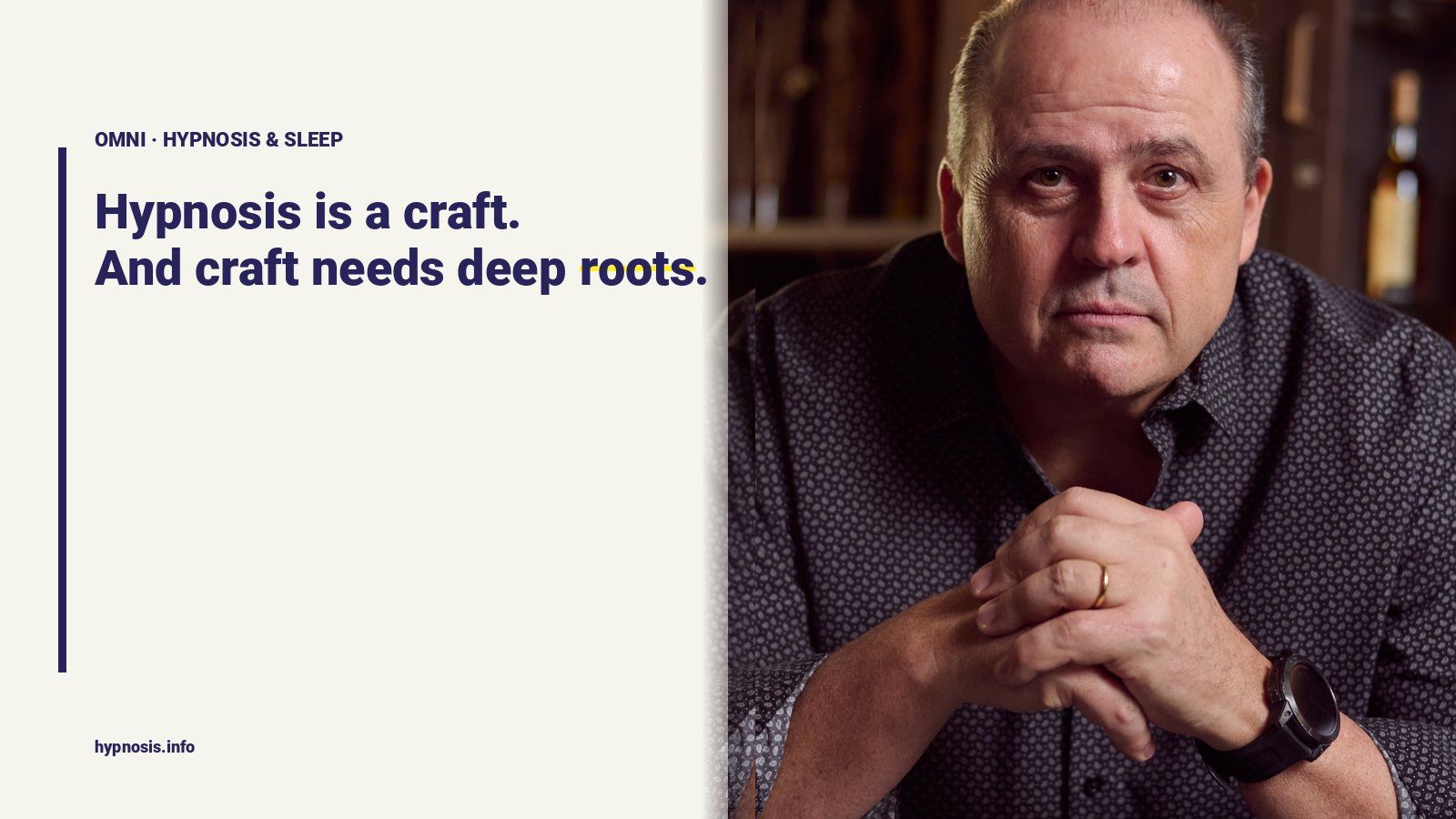
In November 1908, a man named Jacob Kopelman is dying of cancer in the United States. Morphine barely touches the pain anymore. A family friend, a hypnotist whom mainstream medicine does not take seriously, comes to see him. After the session, Jacob’s pain finally eases. He gets a few quiet hours with his six children before he dies. His eight-year-old son never forgets that afternoon. Years later, calling himself Dave Elman, he performs on American vaudeville stages as the youngest and fastest hypnotist of his time, and from 1949 on he teaches what he refined there to physicians and dentists. Across four generations, this lineage led to the OMNI hypnotherapy training we know today.
What hypnotherapy training really is
A serious hypnotherapy training program is not a weekend course in mysticism. It is a structured craft built on three foundations: a clear model of consciousness, a reproducible method, and an ethical framework. The OMNI method teaches all three, based on the work of Dave Elman and his direct student Gerald F. Kein and complemented by modern neuroscience. Graduates do not leave the program with a bag of tricks. They leave able to guide a client into a focused state of mind in which lasting change becomes possible, and with a clear sense of when hypnosis is the right tool and when it is not.
The numbers and the science
The clinical evidence for hypnosis has become more solid in recent years. The umbrella review by Rosendahl et al. (2024) in Frontiers in Psychology analyzed 49 meta-analyses covering 261 primary studies. Hypnosis showed robust effects, especially for pain management, medical procedures, and work with children. Roughly one in four reported effects falls into the large category (a Cohen’s d of 0.8 or higher), the range in which psychotherapeutic interventions match pharmacological ones.
At the University of Zurich, three studies provide a neurobiological foundation. The fMRI study by de Matos et al. (2023) documents shifts in functional networks in parieto-occipital-temporal regions across two distinct hypnotic depths, along with measurably slower breathing. The EEG study by Niedernhuber et al. (2024) in Cortex identifies an interhemispheric frontoparietal network and rising theta activity in hypnosis, even though participants remain awake and focused. And the MRS study (de Matos et al., 2024, Scientific Reports) provided the first evidence of altered myo-inositol concentrations in the parieto-occipital cortex during hypnosis, a cellular correlate of the hypnotic state. Three different methods, three converging findings.
Three fields that shape OMNI training
The training is anchored in real applications.
Medicine and the operating room. In 2024, Swiss roofer Silvio Künzler had an extensor tendon transfer on his hand at Hirslanden Klinik Stephanshorn without conventional anesthesia and without strong painkillers. HypnoDoc®-certified hypnotherapists supported him, and Swiss public television documented the operation. Eight weeks later, he was back in personal training. Earlier procedures at Kantonsspital Baden and at the Geneva University Hospitals had already shown that combining medical expertise with OMNI-trained hypnosis opens doors that were considered closed only a decade ago.
Elite sports. Adrian Brüngger, EHF Master Coach and a former senior manager in finance, first answered Hansruedi Wipf in 2010 in plain words: “Don’t come at me with that hocus-pocus.” Months later, after a 24:38 defeat for the handball club Pfadi Winterthur, he began to integrate the OMNI method systematically into team training. What followed was a 26:25 cup win against BSV Bern Muri, three Swiss cup titles, a Swiss championship, and the first Swiss club in an EHF group stage. The same methodology is behind Niels Hintermann’s World Cup downhill win in Kvitfjell and Samuel Giger’s victory at the 2023 Unspunnen Swiss wrestling festival. American readers will recognize the principle from Michael Jordan and Tiger Woods, who made mental training part of their game long ago, with methods that share roots with hypnotic technique.
Everyday practice and self-hypnosis. Between the operating room and elite sport lies most of the work: insomnia, test anxiety, chronic pain, stress. OMNI instructors such as Sandra Blabl, who teaches in Munich and Cologne, have documented thousands of sessions at each of their locations. In clinical practice, typical patterns emerge, and the OMNI program teaches them as structured processes, not as random tricks.
What makes the OMNI method different
This is where the question of lineage becomes practical. In the mid-twentieth century, Elman developed the Elman induction, a quick and reliable way to guide people into a deeper state. His direct student Gerald F. Kein, born in New Jersey in 1939 and a Navy veteran, founded the OMNI Hypnosis Training Center in DeLand, Florida, in 1979 and turned the work into a curriculum that could be passed on. In 2015, Kein handed the company over to Hansruedi Wipf, a political scientist and former senior executive in the automotive industry. Wipf brought the conviction that therapy should be measurable, reproducible, and quality-assured. In 2015, OMNI became the first hypnosis school to be ISO 9001 certified. That standard opened doors at clinics and universities and ultimately made the research program at the University of Zurich possible. The core of the method has a deliberately unglamorous name: “Regress to Cause and fix it,” or R2C for short. Instead of smoothing over symptoms, OMNI works back to the root of a pattern and resolves it where it began. Students of OMNI hypnotherapy training do not collect techniques. They learn a complete therapeutic framework.
What you can do next
If you have a personal concern, from insomnia to test anxiety to chronic pain, look for a Certified OMNI Hypnotherapist near you. Every one of them has completed the same standardized program described here. If you are not sure where to start, write to us.
If you want to learn the craft yourself, whether as a coach, naturopath, physician, nurse practitioner, or career changer, OMNI hypnotherapy training is the next step. You can train part-time, online or live, built on a structured core curriculum. Graduates who want to go further find their next stage in the OMNI Prime Mentoring program. And at the International Hypnosis Congress in Switzerland in June 2026, the people who bring this work into clinics, sports clubs, and private practices met in one place.
Conclusion
Roots show when a tree stands in the wind. From a quiet living room in 1908, across four generations, Elman, Kein, and Wipf, OMNI has grown into a hypnotherapy training whose induction is used in research at the University of Zurich and whose methods reach the operating rooms of the Hirslanden clinic and the ski slopes of Kvitfjell. Hypnosis is not a miracle, but with hypnosis, miracles become possible. Anyone who wants to guide change honestly cannot really avoid these roots.
Your next step: compare the OMNI training paths and find the one that fits your schedule.
Sources
- Rosendahl, J. et al. (2024). Meta-analytic evidence on the efficacy of hypnosis for mental and somatic health issues: a 20-year perspective. Frontiers in Psychology. Full text
- de Matos, N. M. P. et al. (2023). Investigating functional brain connectivity patterns associated with two hypnotic states. Frontiers in Human Neuroscience. Full text
- de Matos, N. M. P. et al. (2024). Neurochemical dynamics during two hypnotic states evidenced by magnetic resonance spectroscopy. Scientific Reports. Full text
- Niedernhuber, M. et al. (2024). An interhemispheric frontoparietal network supports hypnotic states. Cortex. Full text